Project Description
Full Project Title: How do invasive plants affect the spatial and temporal patterns of fuel structure and moisture, and influence fire regimes?
Invasive plants change the structure and moisture content of grassland and understory fuel beds (i.e., flammability), but this is not adequately accounted for in wildland fire fuel models used by fire managers. Some invasive plants make previously nonflammable areas flammable, while others lower flammability, potentially inhibiting prescribed fire efforts. Our objective is to directly measure the fuel bed characteristics used in wildland fire fuel models from a list of invasive species previously identified as concerning by stakeholders. We will use these data to determine which currently used fuel model best characterizes each species, and create new models when current models are inadequate. These models will allow us to characterize how invasions would change the existing fuelscape, and use fire simulation modeling to characterize how that would change future fire regimes.
The three primary activities of the proposed work are: 1) Directly measure fuel structural characteristics that are used in wildland fire fuel models for invasive species of concern identified by land managers across seven states in the North Central US and Western Great Plains; 2) Measure a multi-year time series of fuel moisture for a representative subset of those species to characterize the seasonality (i.e. phenology) in plant fuel moisture so that managers can more accurately forecast seasonal fire risk in invaded landscapes; 3) Simulate fire activity in different seasons to characterize how and when these species change fire regimes if they invade the major vegetation types in the eastern slope of the Colorado Front Range and the grasslands of Northeast Colorado.
Goals: The proposed work will provide a new toolbox of invasive plant fuel models that land managers and researchers will be able to plug into existing wildland fire fuel models to more accurately assess fire risk and plan for future fires. We will incorporate these into existing decision support tools, improving the ability of land managers to see where on the landscape invasive species will change the fuelscape, which will help them target areas for exotic plant control treatments. Finally, the broader fire science and ecology fields will benefit from a comprehensive analysis of how invasive species of the highest concern might affect fire regimes in the future.
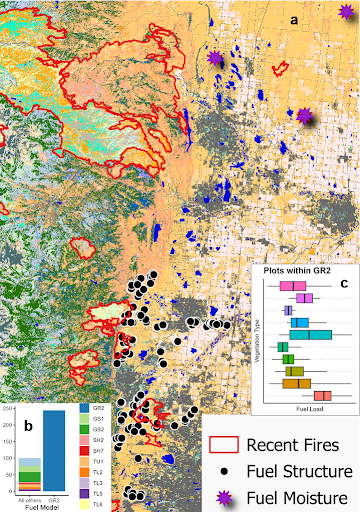
Locations of ongoing monitoring efforts for fuel structure and fuel moisture (a). Background colors are Scott & Burgan (2005) fuel models that are currently used by land managers. Of the 456 fuel structure plots, 244 were classified as using the grassland GR2 model (b, LANDFIRE), despite a wide range of fuel loads and vegetation types across the plots (c).




Funders
