Project Description
Full Project Title: Macroscale Resilience: Assessing the recovery of western U.S. forests to compound disturbance by linking observations—from trees to ecoregions
Across the Western U.S., an estimated 6.3 billion dead trees stand as evidence of increasingly severe and frequent beetle outbreaks, wildfires, and droughts, all intensified by decades of regional warming. Yet, a critical question remains: Are these forests transitioning to new ecological states, or are they showing signs of resilience?
Despite advances in resilience theory, measuring forest recovery, especially in response to compounding disturbances, remains a challenge. To bridge this gap, our research combines field-based forest inventories, uncrewed aerial systems (UAS, i.e., “drones”), the National Ecological Observatory Network’s (NEON) Airborne Observation Platform (AOP), and Landsat data. Our goal is to track plant functional types over time at a landscape scale, providing key insights into forest recovery.
By reconstructing forest dynamics at a spatial scale relevant to land management, this research delivers a first-of-its-kind temporal analysis of ecosystem resilience. We are also committed to developing an open, reproducible methodology that can address ecological questions at regional to continental scales, shaping future forest management strategies.
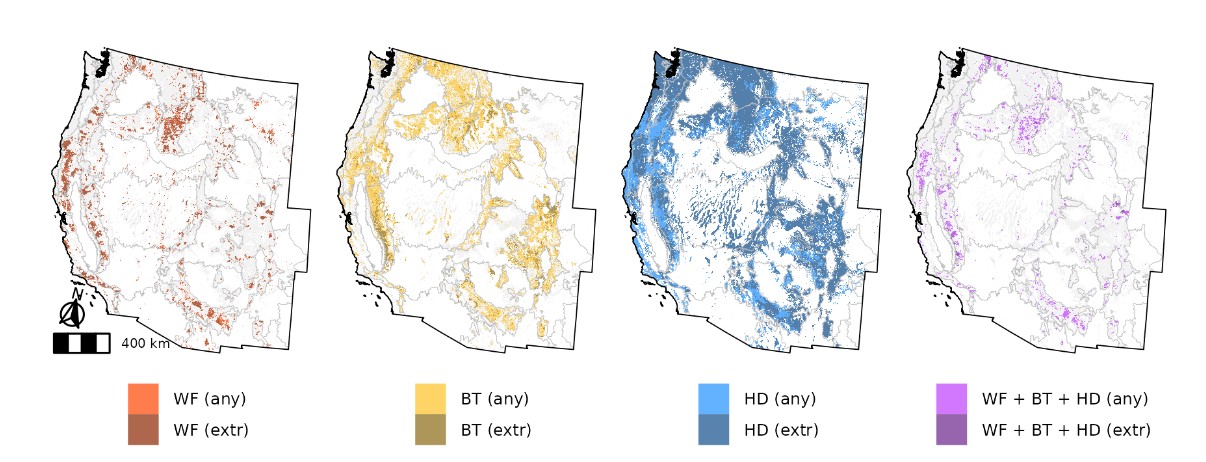
Figure 1. Macroscale “any” and “extreme” thresholds of disturbance legacies across the Western U.S. from 2000-2020, including (WF) area burned by wildfire, (BT) the maximum extent of tree mortality by mountain pine beetle and spruce beetle, (HD) area impacted by drought, and (WF+BT+HD) areas that experience a combination of wildfire, beetle kill, and drought in the same year.
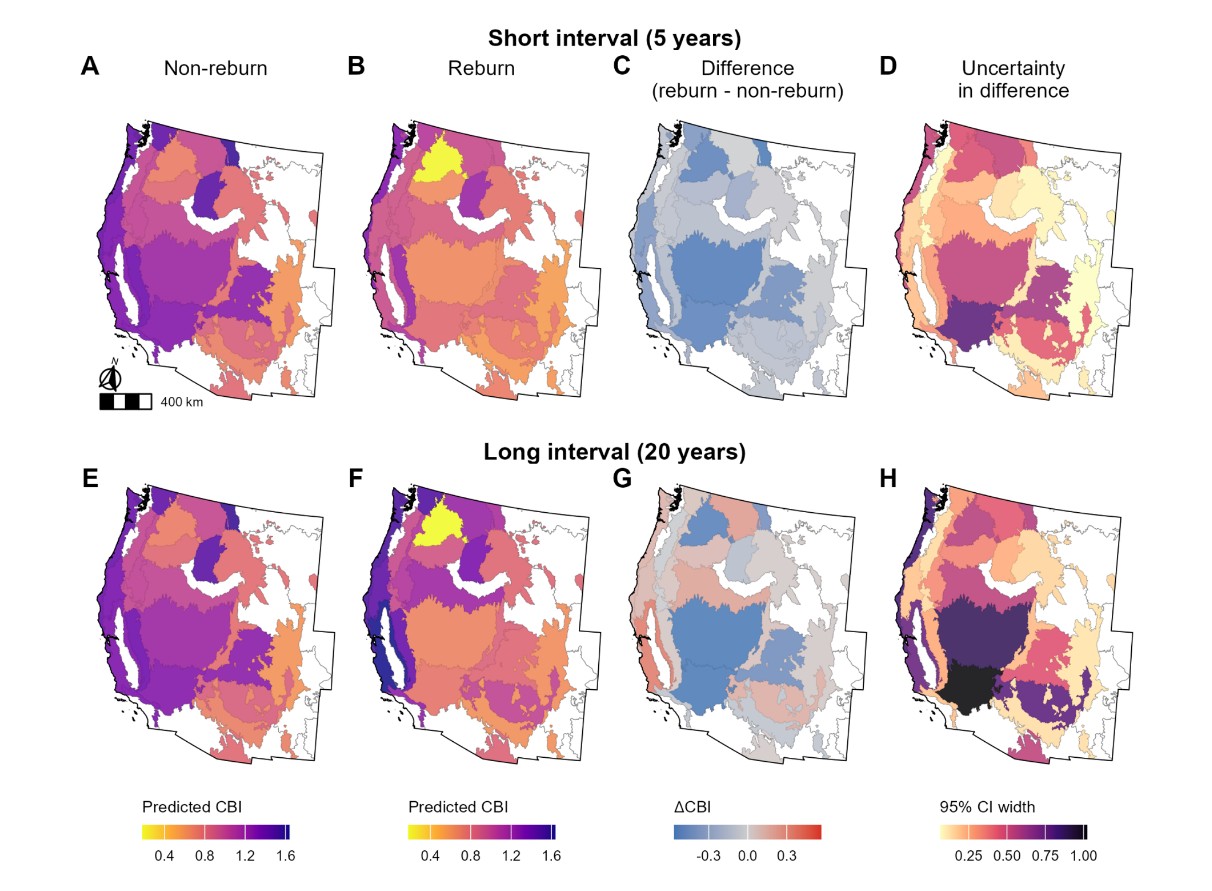
Figure 2. Predicted reburn severity (measured as composite burn index, CBI) across western U.S. ecoregions over short and long reburn intervals from 2001-2020. For short-interval reburns, most ecoregions show decreases in future fire severity due to fuel limitations. Over long-interval reburns, many ecoregion patterns dampen or reverse, with some ecoregions showing increases in future fire severity due to fuel accumulation.
Funding for this project was provided by NSF Award #DEB 2017889.









Funders