Project Description
Project Title: Urbanization and Fire Risk at the Wildland-Urban Interface
This project examines how wildfire spread interacts with patterns of human development across the western United States, with a focus on the wildland-urban interface (WUI), where built environments and natural vegetation meet. As communities continue to expand into fire-prone landscapes, the work aims to better understand how these coupled human-environment systems shape fire behavior, particularly fire speed, a key component of fire risk.
The analysis integrates large-scale fire datasets spanning 2001 to 2024, combining daily fire growth data with spatial information on the WUI, building density, vegetation, terrain, and weather conditions. By tracking fire growth at the daily level, the project evaluates how fires behave as they move through different landscape contexts, particularly when transitioning between undeveloped wildland areas and developed areas in the WUI. Further, we account for key drivers of fire behavior, including time-varying weather, topography, vegetation composition, and the stage of fire progression, and apply causal inference methods to control for these confounding factors to isolate the independent contribution of the WUI on fire speed.
A central component of the work is distinguishing between different forms of development within the WUI, including dispersed housing embedded within vegetation (intermix) and more densely clustered development along wildland edges (interface). The project also examines how these patterns vary across regions of the western United States and over time. Overall, this research treats wildfire as a process emerging from interconnected social-ecological systems, using high-resolution spatial data and rigorous modeling approaches to better characterize how fire behavior unfolds across increasingly human-influenced landscapes.
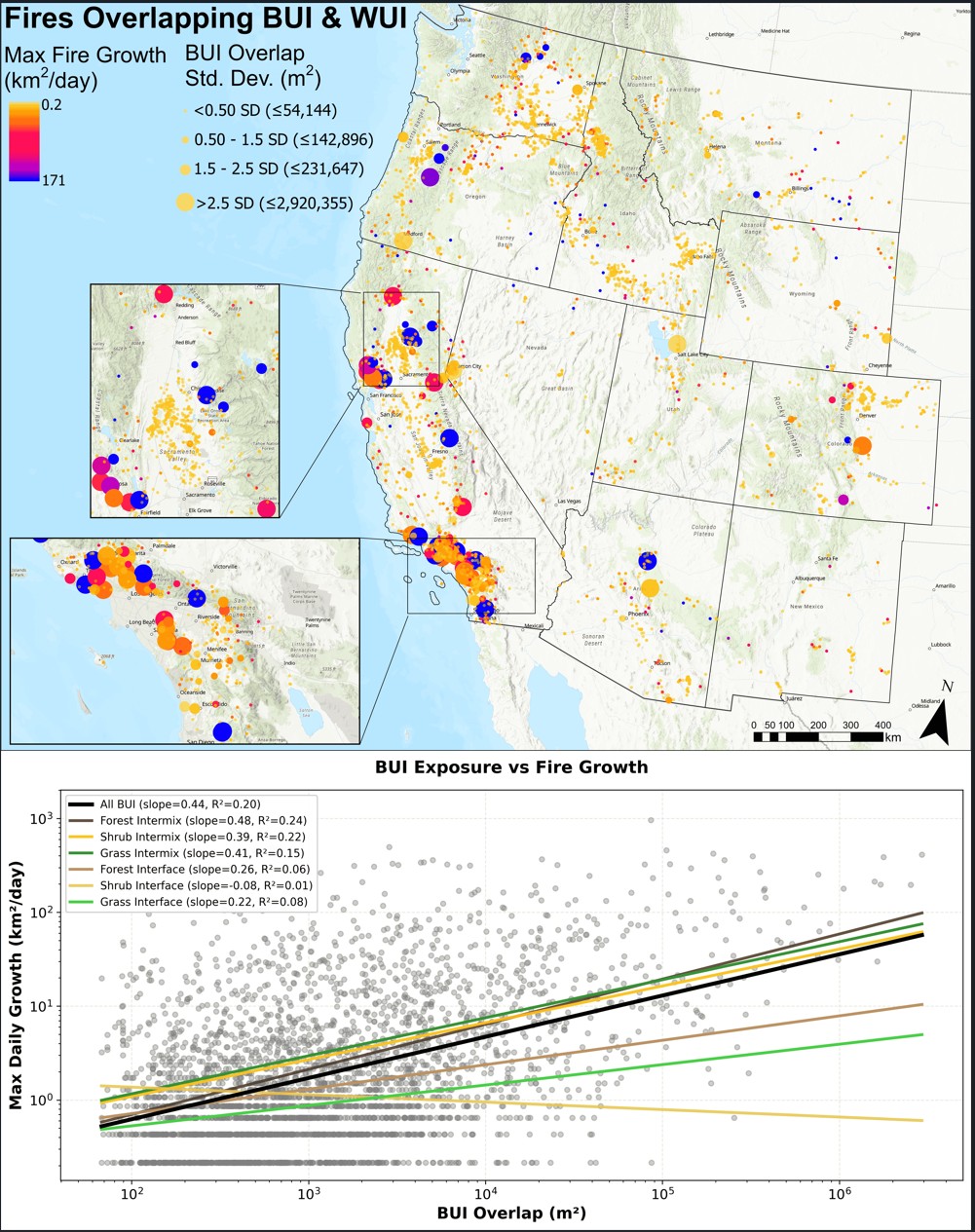
Geographic distribution and scaling of fire-structure interactions.
Team Members: Kyle Manley (CU Boulder), Shijuan Chen (UM Boston), Laura E. Dee (CU Boulder), Nicole Hemming-Schroder (CU Boulder), Virginia Iglesias (CU Boulder), Volker Radeloff (UW Madison), Franz Schug (UW Madison), Karen C. Seto (Yale), Jennifer K. Balch (CU Boulder)
This project was supported by NASA LCLUC Grant: 23-LCLUC23_2-0023, “Urbanization and Fire Risk at the Global Wildland-Urban Interface: A MultiSensor Study of Past and Future Trends”




Funders