Project Description
Full Project Title: Impacts of Wildfire and Prescribed Fire on Cultural Ecosystem Services and Related Social Ecological Outcomes
Public lands across the US support nearly a billion recreational visits each year, sustaining rural economies, physical and mental health, cultural connections, and the diverse ways people relate to nature. These same landscapes are experiencing rapidly intensifying wildfire and a growing push to expand prescribed fire as a management response, particularly in the US West where nearly 50% of land is federally managed. Yet how fire reshapes the recreational use and values of public lands has remained largely unknown, and these values are rarely incorporated into fire management or climate adaptation planning.
This project develops new methods to quantify how wildfire and prescribed fire affect public land visitation at a landscape scale across Colorado and California. We combine novel visitation models built on millions of digital mobility observations from multiple platforms with quasi-experimental causal inference methods to isolate fire's effects from the many environmental and social factors that also influence recreation.
By examining how fire type, severity, size, vegetation, and community context shape recreational outcomes over time, the project reveals the social-ecological dimensions of fire risk that conventional approaches typically overlook. This work aims to provide an empirical foundation for integrating recreation and other non-material benefits of nature into fire management, fuel treatment prioritization, climate adaptation, and equitable investment in fire-prone communities. This project is a product of the CIRES Visiting Fellows Program and the NCEAS MORPHO Rx Working Group.
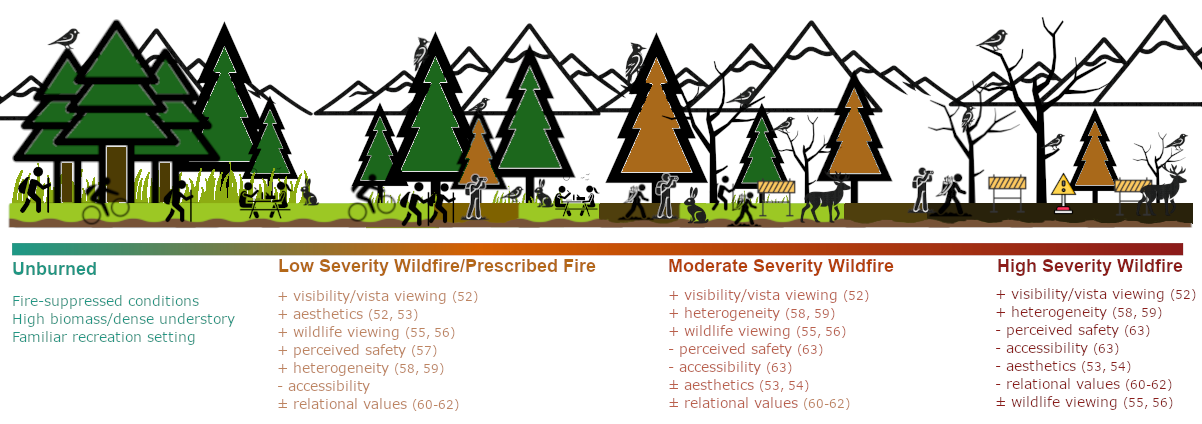
Conceptual diagram of hypothesized mechanisms through which fire impacts recreation across a fire severity gradient. Fire modifies vegetation structure, habitat heterogeneity, biodiversity, and access/closures, shaping recreational experiences through changes in visibility, aesthetics, wildlife viewing, perceived safety, and relational values.
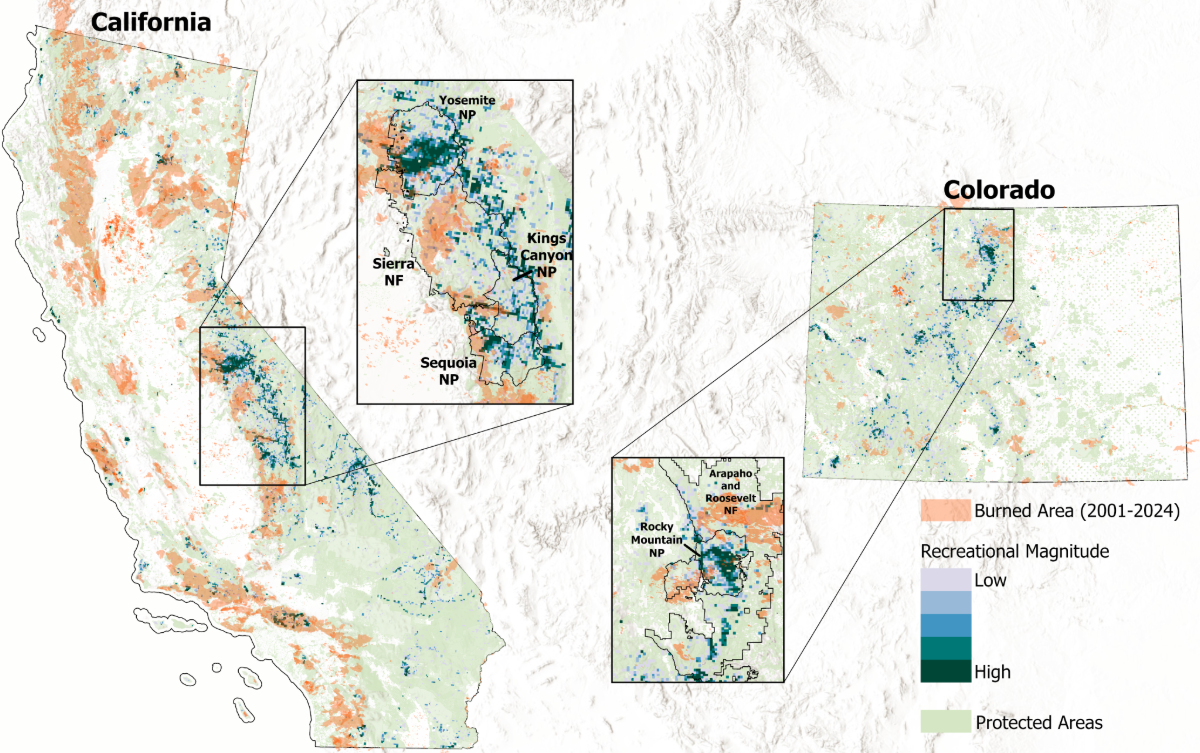
An overview of spatial distribution of recreational use, fire activity, and their spatial intersection across public lands (PAD-US) in Colorado and California.
Team Members: Kyle Manley (CU Boulder), Spencer A. Wood (UW Seattle), Cody Evers (Portland State), Holly Nowell (Tall Timbers), Anna LoPresti (CU Boulder), Katherine Siegel (CU Boulder), Jennifer Balch (CU Boulder), Laura Braun (UW Seattle), Ash B. Cale (UN Reno), Jason Kreitler (USGS), Tyler L. McIntosh (CU Boulder), Jamie Peeler (UM Missoula), Miguel L. Villarreal (USGS), Laura E. Dee (CU Boulder)
This project was supported by the CIRES Visiting Fellows Program, funded by NOAA cooperative agreement NA22OAR4320151. This work also resulted from the Morpho “Fire impacts to ecosystem services in the US West” Working Group conducted at the National Center for Ecological Analysis and Synthesis.
Featured Blogs


Funders